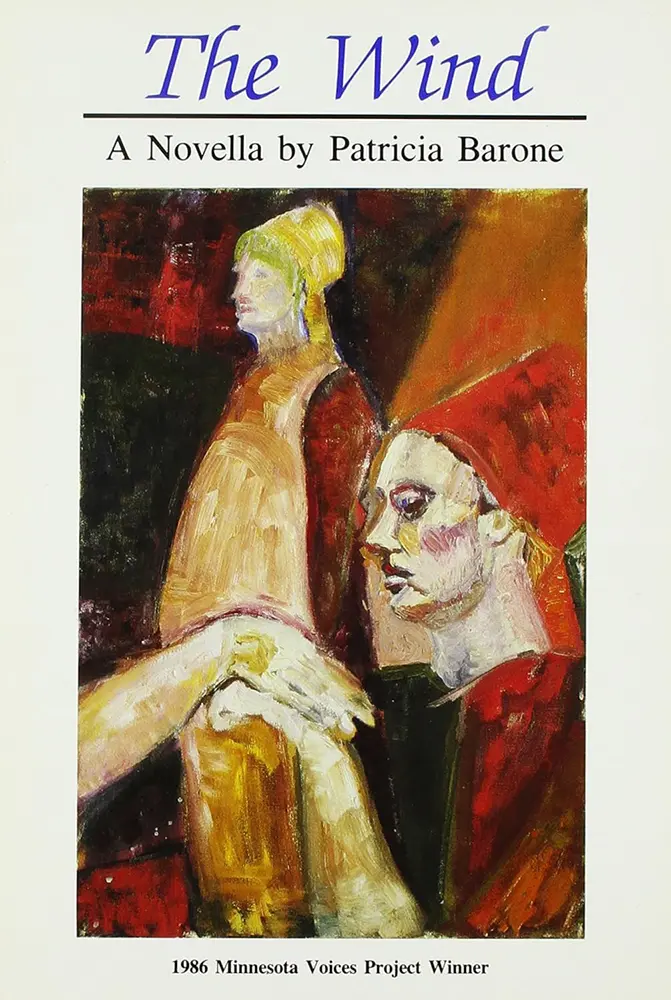
The Wind
New Rivers Press: Winner of the 1986 Minnesota Voices Project Competition
“Jungian symbolism of wind and water, dreams and changing shapes in Fran’s abstract paintings are used effectively as metaphors for psychological uneasiness and growth. Ms. Barone’s handling of such themes as disability and aging, the nature of love in a parent-child relationship and friendship across the generations is compassionate but never sentimental.”
—Linda Barrett Osborne, The New York Times
Praise
“The Wind by Patricia Barone (New Rivers/Talman, Paper, 7.95) Patricia Barone is both a poet and an artist, and not surprisingly, her first novella is infused with the compact beauty, strong imagery and symbolic layering of a painting or poem. The story centers on Fran and Alan, a couple in their 30, and Katherine, 62-year-old psychotherapist with whom they share a Minneapolis duplex as they assist her while she recovers from a stroke.
The birth of Fran’s baby triggers memories of loss for both women—Katherine’s only child died and Fran, whose brother drowned, is exhaustingly protective of her daughter. As friends, they enter into an unusual therapy while Alan seeks new understanding of his Italian American family, particularly his father.
Jungian symbolism of wind and water, dreams and changing shapes in Fran’s abstract paintings are used effectively as metaphors for psychological uneasiness and growth. Ms. Barone’s handling of such themes as disability and aging, the nature of love in a parent-child relationship and friendship across the generations is compassionate but never sentimental.
Her characters are often fearful and irritable—Katherine, for example, chafes at her slow progress after the stroke, “like wading upstream in a long skirt, or one of those dreams in which time is so sticky, so slow, you can see the minutes pull apart—and Ms. Barone never rushes their development. Each works for a deeper understanding of the past so that when they do break through into self-knowledge and acceptance, the reader feels the power of that freedom.”
—Linda Barrett Osborne, The New York Times
“In my clinical practice as a physical therapist, I work with many people who have had cerebral vascular accidents. The Wind accurately describes the physical disability, frustrations, and feelings of disconnectedness that a person undergoes as a result of a stroke. It poignantly reveals one woman’s courageous struggle to regain independence and her ability finally to accept irreversible loss.”
—Diana Nowatzski, member, American Physical Therapy Association
“Patricia Barone describes the strange twists that occur in our intimate lives during initiations transits. A deli at exposure of an our-of-ordinary Jungian analysis moves the story along. Plots of maternal love and loss, disability, and psychological discovery all come together in a south Minneapolis duplex that stands as an image of a ‘complex’ shared by patient and analyst. These chapters unfold like leaves of a long letter from someone I care about and haven’t heard from for several tortuous, transformative years.”
—Nor Hall
“Barone begins this seamlessly crated novel with a charged description of Fran, her heroin, being challenged by a powerful and mysterious wind, while carrying a large painting across the Washington Avenue Bridge in Minneapolis, the flooding Mississippi below. In this opening scene, we are presented with a microscope of the psychological forces at work in Fran’s life. In the intensely lyrical and compassionate narrative that follows, we walk, and sometimes, crawl, along with Fran across that literal and metaphorical Al bridge, toward self-realization and spiritual transformation. Fran comes to view the potentially dangerous water below her, not just as a possible source of death, but as a medium of baptism, of spiritual birth for her daughter Caitlin, as well as for her own ‘inner child.’ It is significant for Barone, and ourselves, that Fran learns to ‘enter the wind’ which threatens her safety; that she heals herself, gives birth to herself through her own interior labor; that she brings order out of chaos through her art Near the end of this daringly human novella, Barone describes Fran’s latest painting as ‘… a luminous pulsating cloud, or amnion, too formless to be a womb, and our of it — some joyful kicking.”
—Michael Moos
“This novella evolved from a short story and before that a poem and is accompanied by drawings by the author. Art, psychology, and family relationships combine in a story about a young woman artist coming to terms with motherhood while trying not to shortchange herself professionally. As any clerk-typist can verify, this balancing act required of so many women today has its disadvantages. On the surface, Fran has an easier time of it than many young women. Her husband Alan puts his ambitions as a fiction writer on hold in order to take a journalist job which will enable Fran to stay home and paint. They move into a duplex with Katherine, a psychologist recovering from a stroke, providing Fran with a mother figure and eventually with a structured therapy program. All of this “help” may not be what Fran needs, however, as she discovers. Neurotic and seemingly fragile, Fran stops whining and develops emotional strength as Katherine recovers physically. Even Alan seems to come to terms with his frustrations and attempts to sort out an uncertain and complex relationship with his father. It is unlikely that The Wind will appeal to general readers, but therapists and anyone going through a difficult time mentally or physically will appreciate Barone’s insight into recovery from a Illness.”
—Mary Prokop, Savannah, GA
“In this first novella by Patricia Barone, two women meet by chance and become companions in transitional phases of their lives. Fran, 31, an artist, is emotionally crippled by unfinished grieving for her brother Michael, drowned at age four. Isolated by self-doubt and fears about her competence, she has difficulty making commitments of revealing herself, even to those she loves. Her malaise is expressed in her enigmatic paintings and her recurrent encounters, in dreams and in life, with an irresistible and terrifying wind. Her paralysis of soul is mirrored by the bodily paralysis of Katherine, a psychologist and stroke patient, who enlists the help of Fran and her husband Alan in her transition from hospital to home. They each sense their need of the other and and, together, crawl toward resolution. Ultimately, both come to terms with their handicaps. Katherine accepts the residuals of her stroke, the fact that “she had been going somewhere and all of a sudden she wasn’t,” and the need, for Fran’s sake, to let her go. Fran begins to understand her unhealthy protectiveness of her baby daughter and faces her feeling of guilt and sadness over Michael’s death, “entering the wind” and letting go of fear and indecision. This book began as a poem, then became a short story then a novella. Perhaps it would be more satisfying if it had gone a step farther. It is so densely written, in psychological terms, and is so sparing of physical detail that one is left with the impression of shadow figures, disembodied psyches, moving through a dreamscape. The art works (by the author) are also of time and place, and the dialogue has a disjointed musing quality, as if every character were talking to an inner self, rather than another person. Perhaps if this story were more fleshed out with more detail and allowed a more organic unfolding of the layers of complexity in these characters’ lives, it would engage the reader more. It is difficult to identify sympathetically with only the psychological aspect of these people without the psyche being housed its recognizable bodies, performing familiar tasks. The histories of the characters are well developed – in fact, Fran’s and Alan’s families are more accessible than they are. Resolution comes rather quickly at the very end of the work and seems rushed int elation to the amount of change required, again leaving one wanting to know more. The premise of the story is imaginative and balanced but too large, perhaps for the novella form.”
—Anne Gower